

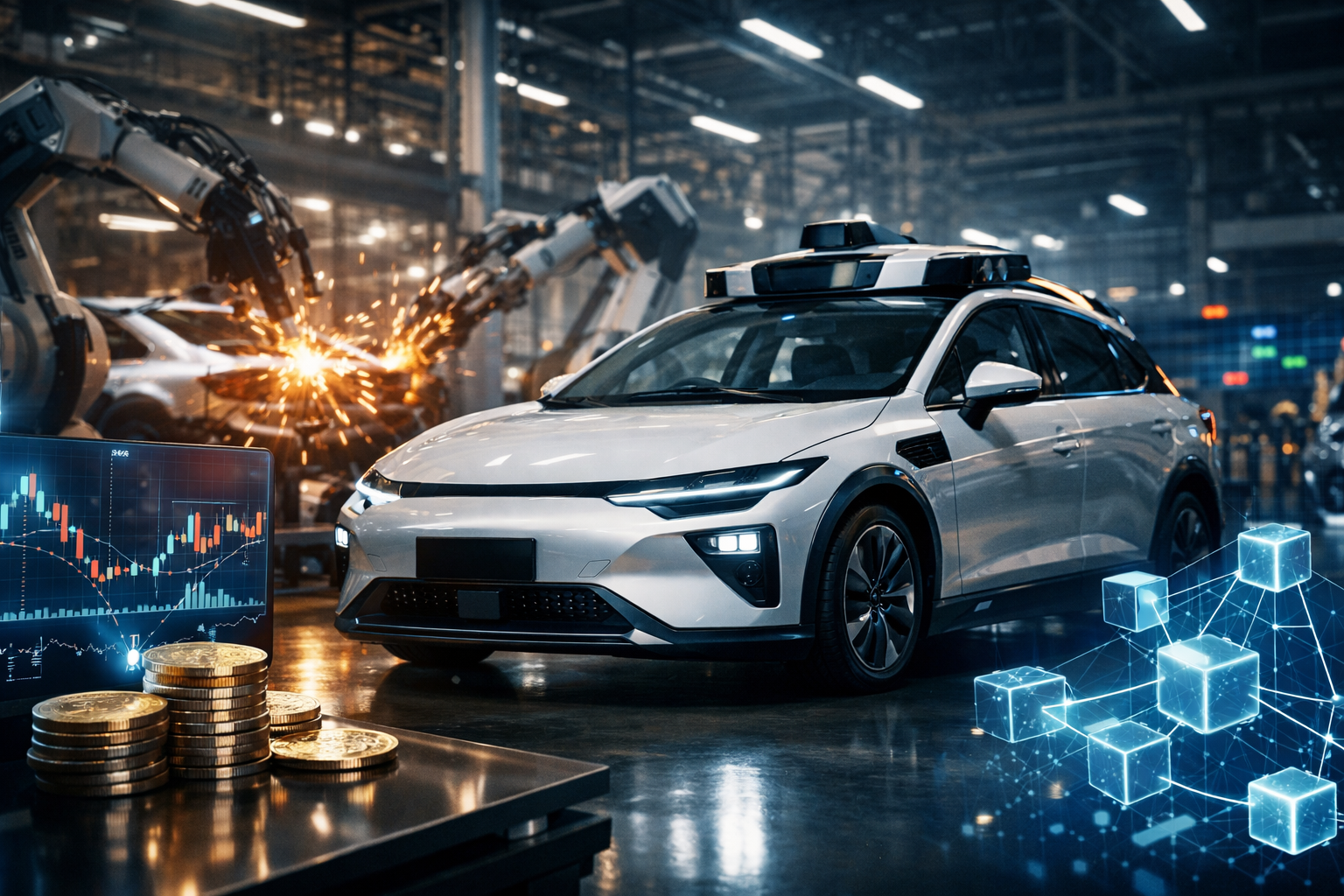

Xpeng Inc. (NYSE: XPEV) has taken a significant leap in its autonomous driving journey by commencing mass production of its first robotaxi at its Guangzhou headquarters. This milestone marks a pivotal shift from development to large-scale commercialization of Xpeng’s driverless mobility strategy.
Despite the excitement surrounding this development, investor sentiment has been notably cautious. Following the announcement, Xpeng’s stock experienced a decline as traders assessed execution risks, mounting competition, and the high capital requirements associated with scaling autonomous fleets.
This trend highlights a recurring theme within the electric vehicle (EV) and robotics sectors: technological advancements often do not yield immediate positive impacts on stock performance.
Robotaxi Production Officially Begins
The company confirmed that production of its first robotaxi model has officially begun, utilizing Xpeng’s proprietary GX platform. The vehicle is noteworthy as it has been developed using entirely in-house technologies, reflecting Xpeng’s strategy to minimize reliance on external suppliers for critical autonomy systems.
Xpeng’s plans aim for significant production volume increases over the next 12 to 18 months, with targets set for “hundreds to thousands” of units. This ramp-up is foundational to the company’s pilot operations scheduled for the latter half of 2026, with a full rollout of driverless services expected by early 2027.
Brian Gu, Xpeng’s President, emphasized the company’s readiness to transition from prototype deployment to real-world commercialization, especially as competition intensifies within China’s autonomous driving sector.
Low-Cost Autonomy Strategy in Focus
A core element of Xpeng’s robotaxi strategy is its commitment to cost reduction. The company has developed its autonomy stack around camera-based perception systems, deliberately steering clear of higher-cost technologies such as LiDAR and high-definition mapping.
The VLA 2.0 autonomous driving model relies on data from seven cameras, facilitating perception and decision-making without a heavy dependency on HD maps. This innovative approach aims to streamline production complexity and operational costs, positioning Xpeng to offer robotaxi units priced below 200,000 CNY (approximately US$29,100).
Additionally, the company is leveraging its existing manufacturing infrastructure to enable rapid scaling without the need to establish entirely new production systems. This focus on cost-effective design empowers Xpeng to compete vigorously in a market where profitability remains elusive for many autonomous vehicle developers.
Market Reacts to Execution Risks
While the announcement signifies advancement in Xpeng’s long-term autonomous vehicle roadmap, investor reactions have been tempered with caution. Shares have declined as market participants ponder the company’s ability to successfully scale production, ensure the safety of autonomous systems, and secure regulatory approvals across various markets.
This sentiment reflects broader skepticism regarding robotaxi development on a global scale. Despite demonstrating technological breakthroughs, the path to full commercialization has frequently proven longer and more capital-intensive than anticipated.
Xpeng’s shift toward mass production also places the company under heightened scrutiny, as its operational performance and safety outcomes will now be evaluated at scale rather than within controlled pilot settings.
As Xpeng continues to advance in robotaxi deployment, its strategy integrates low-cost hardware design, in-house software development, and potential ecosystem expansion. However, for the time being, investor focus appears fixated on immediate execution risks, which likely account for the stock’s recent downturn, despite the achievement of this significant milestone.

