

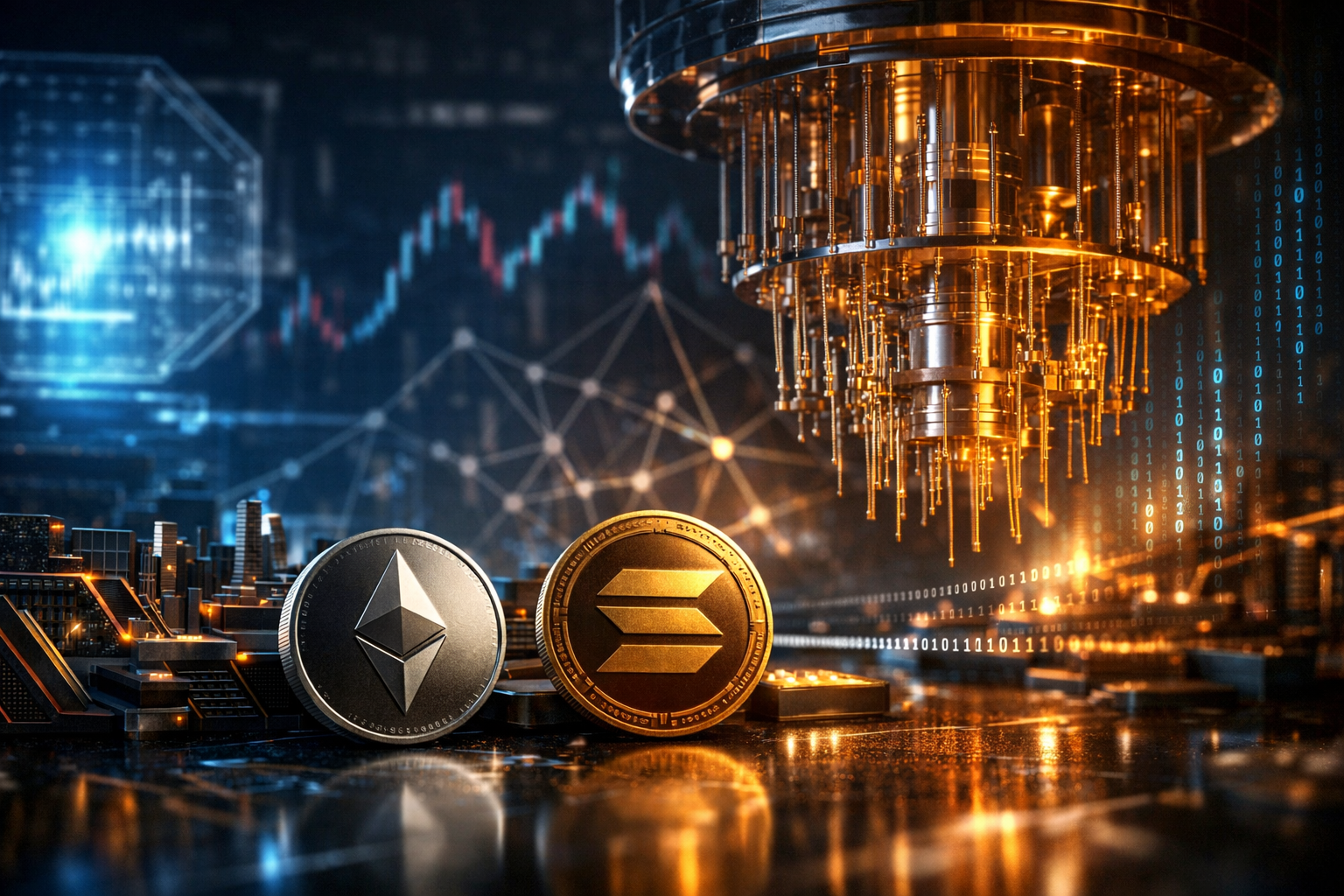

In a striking assertion that sends ripples through the crypto community, Solana co-founder Anatoly Yakovenko recently cautioned that Ethereum Layer 2 (L2) networks are not equipped to withstand the impending threats posed by quantum computing. During a developer update on May 2, 2026, Yakovenko delivered a stark message: “Ethereum L2s are not quantum safe, abandon all hope.” His remarks surfaced amidst a broader discussion around quantum resistance, reflecting his concerns over the vulnerability of current cryptographic systems.
The concern centers on the cryptography underpinning these Ethereum solutions, which primarily rely on the Elliptic Curve Digital Signature Algorithm (ECDSA) using the secp256k1 curve. Unfortunately, this technique is at risk of being compromised by future advancements in quantum computing. A sufficiently powerful quantum computer could, in theory, reverse-engineer private keys from on-chain data, leading to potential asset breaches.
Yakovenko’s warning particularly spotlights a “harvest now, decrypt later” threat. He explained that malicious actors could store transaction data now, leveraging quantum computing capabilities in the future to decrypt that information using the notorious Shor algorithm.
Moreover, the zero-knowledge proofs employed in rollups, including those in zkEVM frameworks like Groth16 and Plonk, also confront existential risks. These systems, which hinge on elliptic-curve pairings, may face substantial barriers against advanced quantum systems.
Solana’s Strategic Shift to Quantum Resilience
In this critical context, Solana is proactively addressing the quantum challenge with plans to integrate Falcon-512, a cutting-edge signature scheme that offers enhanced resistance to quantum threats. Both Solana clients, Anza and Firedancer, are working diligently to deploy this robust defense mechanism.
Future accounts on the Solana network are set to adopt Falcon-512 as their primary security measure. Moreover, pathways for migrating existing wallets to this new standard are being developed, although Yakovenko reassured users that no immediate disruption to the network is anticipated.
Furthermore, Yakovenko pointed out the additional looming threat posed by artificial intelligence, asserting that AI could potentially undermine post-quantum cryptographic schemes before the broader crypto ecosystem has effectively fortified its defenses.
“I think the biggest risk is that post-quantum cryptography (PQC) signature schemes will get broken by AI. We don’t yet know all the possible vulnerabilities, both in implementation and in mathematical underpinnings,” Yakovenko noted.
To bolster security against these threats, Yakovenko proposed the implementation of a two-of-three multisig approach, which would merge various signature schemes within Solana’s transaction processing through Program Derived Addresses.
The Bitcoin Conundrum
On a related note, Alex Thorn from Galaxy Digital highlighted a growing consensus regarding Satoshi Nakamoto’s closely guarded 1.1 million Bitcoin, stored across approximately 22,000 P2PK addresses. Thorn hinted that any potential quantum attack would necessitate cracking each address individually, presenting a formidable challenge for attackers.
Additionally, Thorn expressed confidence in Bitcoin’s resilience, suggesting that the market could absorb substantial selling pressure without sacrificing fundamental property rights.
While Solana and Ethereum tackle the quantum question, other platforms like Cardano and Algorand are advancing their own post-quantum research efforts. Ripple, on its part, has committed to achieving quantum-proof status by 2028. As developments unfold in this nascent field, Bitcoin seems to be navigating its own path towards securing itself against future quantum threats.

