

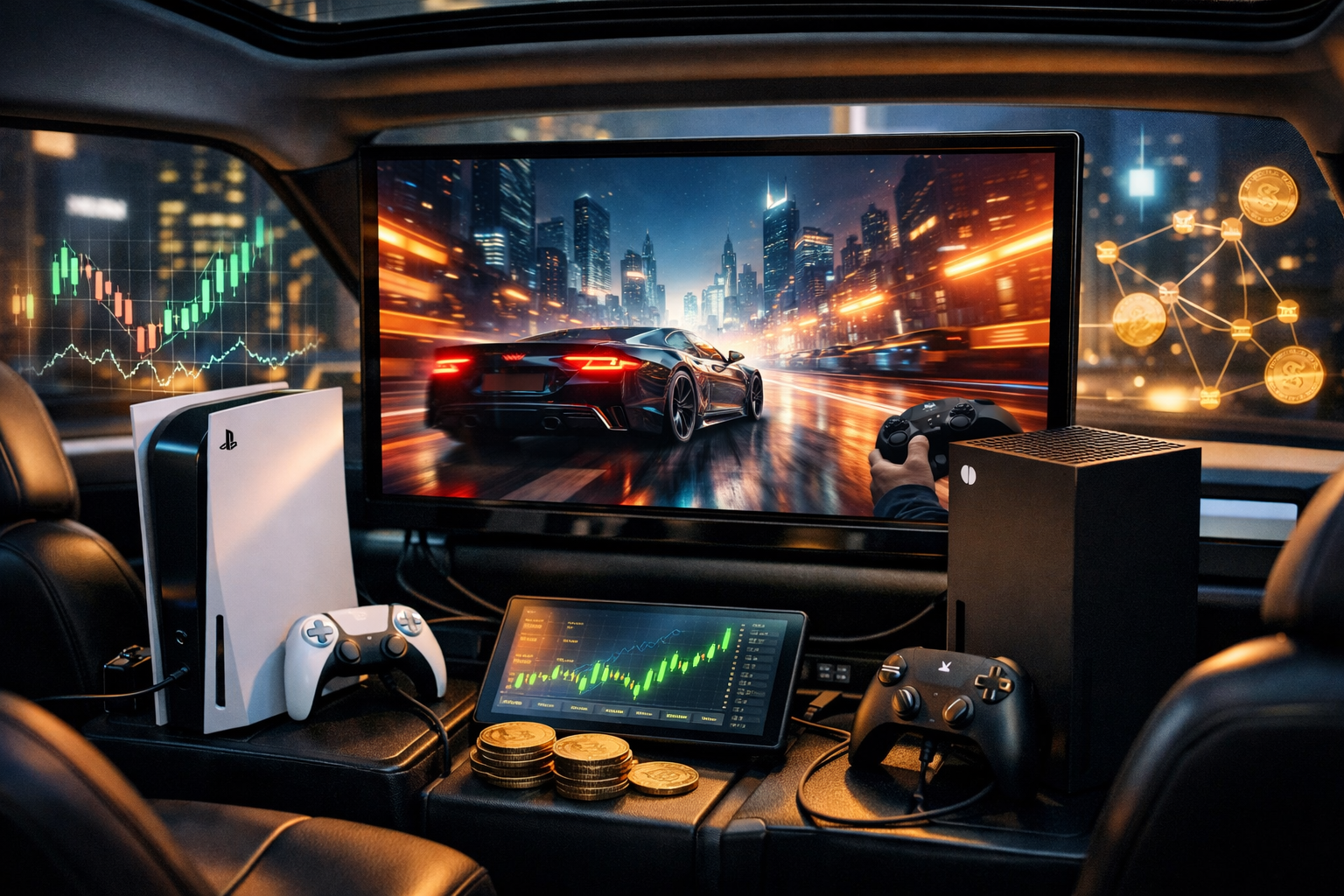

Tesla’s Cybercab is poised to redefine in-car entertainment, allowing passengers to plug in their PlayStation or Xbox consoles directly into the vehicle’s impressive 22-inch touchscreen. This groundbreaking feature was recently confirmed by Elon Musk, who is keen on enhancing the user experience beyond traditional in-vehicle gaming systems.
The announcement came alongside stunning visuals showcasing the Cybercab’s entertainment capabilities, which include pre-installed cinema, music, and gaming applications. This shift marks a significant departure from Tesla’s previous approach, focusing on integrating external gaming consoles rather than relying solely on its own game library.
Transitioning from Tesla’s Own Gaming Features
Since 2019, Tesla has incorporated in-car gaming for its vehicles, initially introducing arcade-style games for users parked at charging stations. The more advanced 2021 Model S and Model X featured dedicated graphics hardware boasting around 10 teraflops of processing power, rivaling that of the PlayStation 5.
However, following a brief foray into Steam support for their new models in 2022, Tesla removed the platform in 2024 due to hardware updates. Musk previously dismissed the idea of developing a competing console, emphasizing that it would be redundant when existing platforms could be utilized for gaming.
Features of the Cybercab
The Cybercab is a fully autonomous vehicle, operating without a steering wheel or pedals, currently providing rides in Austin with no human driver required. Its cabin is designed to be a mobile entertainment hub, featuring a wide array of pre-installed apps for movies, music, and gaming, with plans for Starlink V5 hardware to ensure robust in-cabin internet connectivity.
Musk confirmed that the Cybercab’s hardware configuration will enable users to physically connect their gaming consoles, allowing for seamless video, audio, and controller input through the car’s expansive touchscreen. This innovation shifts the screen’s role from a driver interface to a passenger-focused entertainment display, maximizing the potential for leisure during travel.
However, the Cybercab’s full console capabilities will need to navigate regulatory considerations. The National Highway Traffic Safety Administration has previously scrutinized Tesla for in-car gaming distractions, leading to the temporary disabling of gaming features while in motion. The ability to use consoles will depend on local regulations governing autonomous vehicles.
This development presents an exciting opportunity for game publishers like Sony and Microsoft. The Cybercab serves as a new display terminal without requiring any additional hardware investments, allowing gamers to retain their existing libraries and save files.
Tesla’s role in this setup focuses on providing the screen, power supply, and connection points, while content and game licenses remain with the console manufacturers. Currently, the Cybercab is operational in Austin, though details about a broader release for its console connectivity feature have yet to be announced.

